Who visited it?
Why?
How?
Is my website popular in a parallel universe?
Before Kindle Serveur gets suspended for the third time, let me explain what it actually is.
Kindle Serveur is a very innocent personal project.
Years ago, it was just a dashboard page for a Kindle 3 (Kindle Keyboard) e-ink device — a simple page refreshing every 5 seconds. Later, the Kindle’s screen broke (RIP ), so I repurposed Kindle Serveur as a second monitor.
No users.
No public audience.
No underground traffic syndicate.
At this point, if this keeps happening, I’ll probably abandon PHP, switch to Python, and maybe stop looking at my hosting panel altogether — it clearly knows things I don’t.
Anyway… any idea why my unused website is apparently living a very active social life?
The 5-second refresh was something I used years ago, back when I was using an e-ink Kindle tablet. For the second-monitor setup, the refresh interval was increased significantly. I don’t remember the exact number of minutes, but it’s definitely not every 5 seconds anymore.
Also, this site had been running for about 3 weeks without any issues. If the refresh interval was the real problem, I would have noticed it much earlier during development, not suddenly out of nowhere.
That’s why I’m confused about why it happened all of a sudden.
99.9% of the times those “unknown”, “private”, “nobody-else-but-me” websites, are not actually private.
It’s running on a public server, a public domain. Bots, automated programs, and something like that, will find your site eventually. And they generate a ton of hits.
I left 0.1% for that the counter is actually wrong but this is highly unlikely.
Free hosting doesn’t keep any logs unfortunately so you cannot get to know what exactly is generating these hits.
If you login to your account’s control panel, you will see that you didn’t just hit the limit, you went over it by a very long margin.
Like @Meishin said: we don’t store access logs, so we have no way to say anything else about the traffic. All I can say for certain is that there was a lot of traffic.
You don’t know that for sure; it’s possible a visitor or a search engine bot was crawling your site, or a piece of your PHP/HTML code triggered the block. Also, if you have a page that refreshes every 5 seconds, leaving that open on any device could be the cause.
Just to clarify one more time: the 5-second refresh was from a very old setup. I honestly don’t remember the current refresh interval anymore, but it’s definitely much longer now (minutes, not seconds).
At this point, I think the realistic options are:
Stop using this site to host dashboard-style files and instead run it locally on my own computer,
Convert the current site into a simple, static single-page website,
Or completely redesign it as a dashboard that updates only once every 15 minutes.
So my question is: what would you recommend as the best approach here?
Would adding something like Cloudflare protection actually help in this situation, or is free hosting simply not suitable for this type of project at all?
At this point it doesn’t even matter how long you update the page or don’t do update at all. If a million bot visits your website, they will use up all of the hits, even if you don’t update the page at all.
And you cannot setup Cloudflare on a free subdomain.
You probably have no choice but to run it locally.
After the 24-hour suspension period ended, my account was suspended again due to hit limits.
I would like to clarify that I did not access or use the website at all after the suspension was lifted. As soon as the account became active, I logged in only to check the control panel. Before I could even open the file manager, the account was suspended again.
No files were modified, no pages were opened in a browser, and no refresh-based pages were running.
Because of this, I am confused about what could be generating such a high number of hits immediately after the account becomes active. Is it possible that automated bots or crawlers are accessing the domain as soon as it is re-enabled?
I would appreciate any clarification on what could cause this behavior, and whether there is anything I can do on my side to prevent it.
In case you decided to take this route, kindly consider this similar issue from Jri-Creator:
Jri-Creator’s site did find success. But we have no idea how was your site’s design consuming/managing resources. Only indication is the suspension. Then add the bots in the equation. You can try redesigning but note that free hosting sites don’t cater much to resource-intensive apps.
@siglo_ph Thanks for the example and the reference.
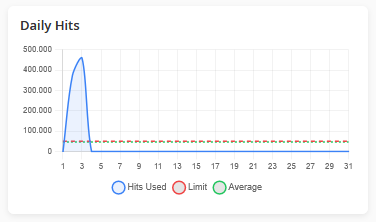
Regarding the auto-refresh concern: the 5-second refresh was part of a very old setup. The current version of the project was already adjusted with a much longer refresh interval (minutes, not seconds). This is also reflected in the Daily Hits graph, where the site was consistently receiving only 13–20 hits per day for weeks.
I’ve shared the hit graph from the suspended account, which clearly shows a sudden and extreme spike compared to the normal baseline. This spike happened without any changes on my side.
Additionally, I switched to a backup site with a similar setup. On the backup site, there is no abnormal hit behavior at all, which makes this situation even more confusing.
I fully agree that free hosting is not suitable for resource-intensive dashboards, and I’m already planning to either:
Convert this into a static, low-request site, or
Redesign it as a dashboard that updates once every 15 minutes, or
Run it locally / move to paid hosting
However, given the long stable period and the comparison with the backup site, I wanted to highlight that the spike does not appear to be caused by continuous auto-refresh or normal usage.
There’s nothing to do with how often you update the page. Don’t even think about it.
This is clearly an attack, and if running locally would work, just run it locally.
At this point, I’ll pack things up and move on. Unfortunately, this means I’ll be closing the website and my free hosting account — which is a bit disappointing, but clearly this platform isn’t suitable for this use case.
I’ll continue using my dashboard by moving it to a local Python-based setup, where I have full control and don’t have to worry about unexpected traffic or hit limits.
For now, I’m also keeping an eye on the backup site while I finish rewriting the project in Python.
Thanks for the information and explanations — I appreciate the help.
Hello,
You can convet it into a static, low-request site that you host locally. And also you can use python or something to make it and to make it anybody can view the website you can use REMOVED.
Let me know if you need more help!
Gavin Codework

 DOMAIN SUSPENDED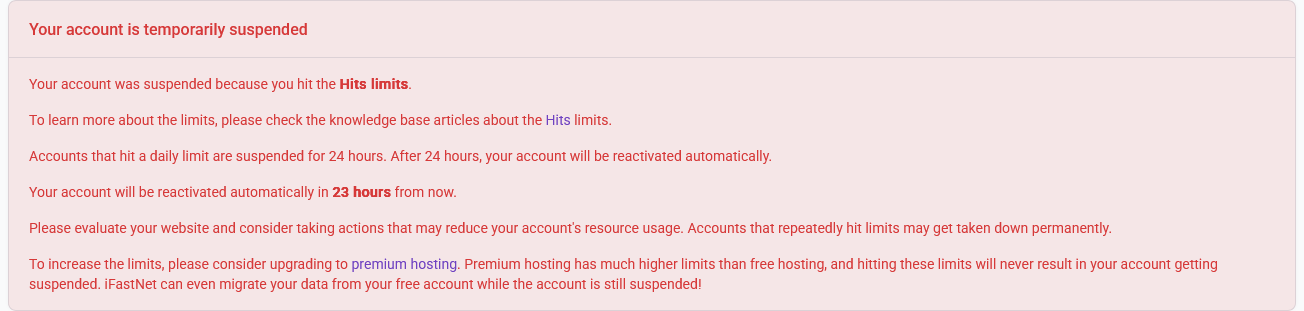
 ), so I repurposed Kindle Serveur as a second monitor.